
It’s 8:30 a.m. Eastern on a Wednesday at the cargo area of Miami International Airport. On the trailer is an aircraft engine in its transport stand, 13 feet 6 inches wide, bound for a shop in Houston, and the escort car has just pulled up behind it. Everything both drivers need for the trip is in one link on their phones.
What does the driver get?
When Permigo files a trip, its office texts one link to the truck driver and to each escort car, and emails it to the dispatcher. It opens in the phone’s browser, with no app and no login. On it: the route on a map, each state’s permit as a PDF, an AI summary of each permit, and the escort cars’ numbers and meeting point. It runs on FleetLynk, Permigo’s permit platform, and each permit appears once Permigo’s office receives it. Every trip Permigo files comes with one, at no extra charge.
What’s in the link
In October 2026, Permigo sent this link on a real run from Oklahoma City to Longview, Texas: 343 miles, two permits and one rear escort car. The screens below come from a separate sample trip FleetLynk built for this guide. Every name, number, time and permit number on them is invented; the state rules on this page are real, read on October 8, 2026.
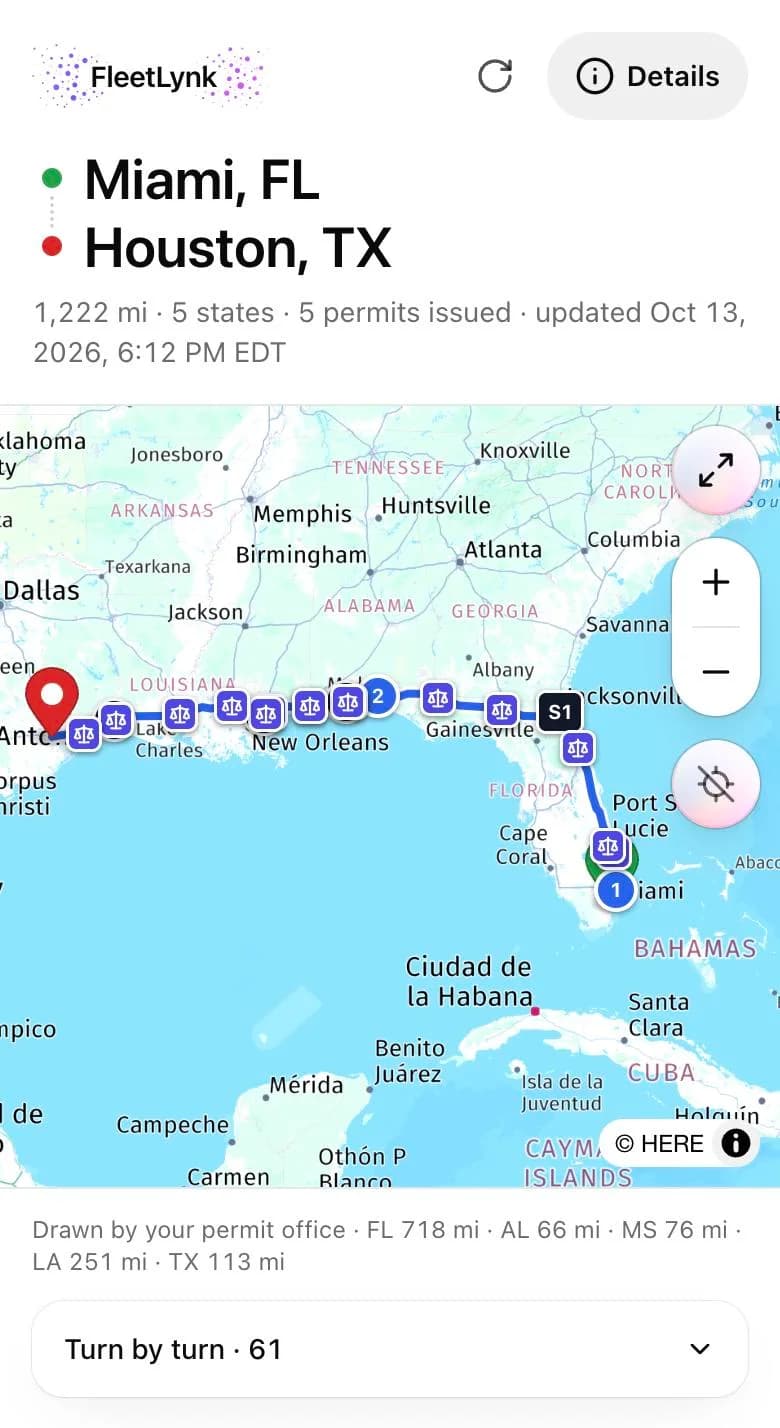
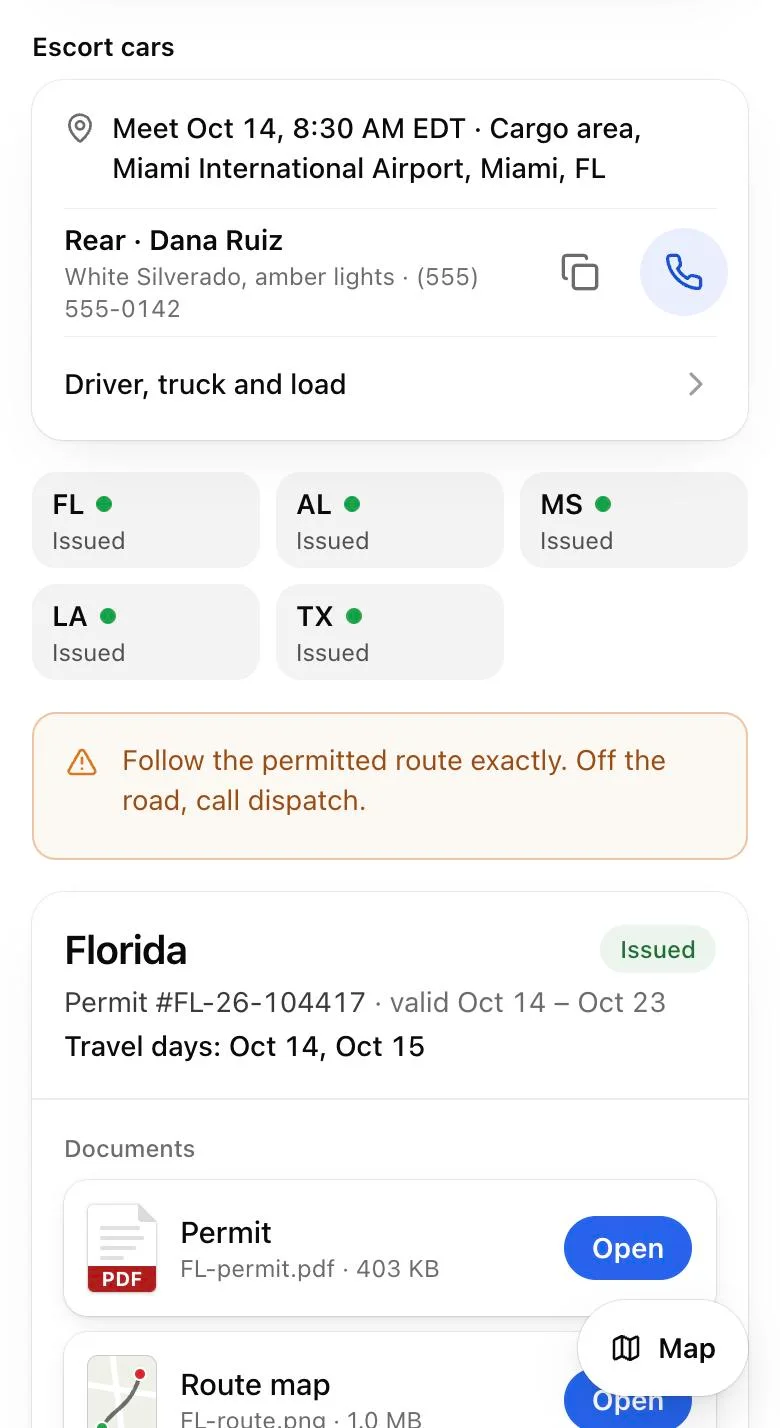
From the top of the page down:
- The trip: where it starts and ends, the miles, how many states and permits are issued, and when the page last changed. Refresh pulls the latest.
- The map, with the whole route as one line, the weigh stations along it and each state’s miles under it. It opens full screen, and the location button follows the truck along the line; Trip details tells the driver, “Only you see your location — it isn’t shared with the office.” When the office drew the road, a Turn by turn list follows, each turn at its mile.
- Escort cars: the meeting line first (“Meet Oct 14, 8:30 AM EDT · …”), then each car by position, driver and vehicle. A tap calls the car.
- A status badge for each state: Issued, Not issued yet, Not needed or No permit. A state still waiting on its permit can say, “This page updates when it’s issued.”
- The standing rule: “Follow the permitted route exactly. Off the road, call dispatch.”
- A card for each state, with the permit number, the dates it is valid, the travel days, the permit PDF, the state’s route map and any form the state wants carried with the permit. Under them sit the AI summary and the state’s own written directions.
- The footer: “Shared by your permit office,” and the date the link stops working, 90 days after the office creates it.
Example: Miami to Houston on I-95 and I-10
The trip runs north on I-95 from Miami to its junction with I-10 in Jacksonville, then west on I-10 across the Florida Panhandle, Alabama and Mississippi, around New Orleans on I-12, and on I-10 again through Baton Rouge and Lake Charles into Houston: about 1,222 miles and five permits. At 13 feet 6 inches wide, the load needs something different in each state.
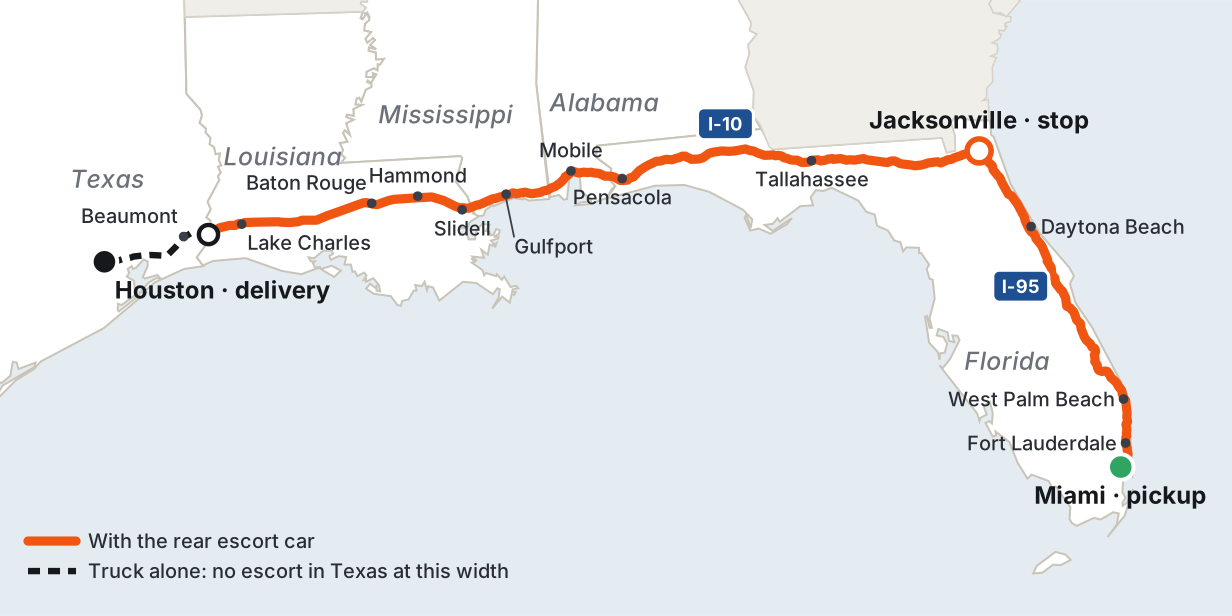
With the rear escort car Truck alone: Texas asks for no escort at this width
What escorts does a 13 ft 6 in load need on I-10 from Florida to Texas?
A load 13 feet 6 inches wide on a divided highway needs one rear escort in Florida, Alabama, Mississippi and Louisiana, and none in Texas until it is over 14 feet wide. On narrow lanes, narrow bridges and busy roads, Florida wants two escorts unless the load carries four warning lights. Permigo read the rules of the Florida, Alabama and Mississippi departments of transportation (FDOT, ALDOT, MDOT), Louisiana’s Department of Transportation and Development (LaDOTD) and the Texas Department of Motor Vehicles (TxDMV) on October 8, 2026.
| State and miles | Escort | When it may move |
|---|---|---|
| Florida 718 mi | 1 rear escort, over 12 ft wide. Over 12 ft up to 14 ft wide, Rule 14-26.012 requires two escorts, front and rear, on lanes under 12 ft, on bridges under 30 ft curb to curb, and on roads carrying more than 12,000 vehicles a day per lane in rural areas or 8,000 in urban areas of more than 50,000 people. At least four warning lights on the load, two front and two rear, keep it at one. | Daytime only. Over 12 ft wide: not 7–9 a.m. or 4–6 p.m. on weekdays in the counties and cities the state lists |
| Alabama 66 mi | 1 rear escort, over 12 ft wide | Daylight only, and never on a Sunday |
| Mississippi 76 mi | 1 rear escort, 13 ft wide and over | Over 12 ft wide: 30 minutes after sunrise to 30 minutes before sunset |
| Louisiana 251 mi | 1 rear escort, over 12 ft wide | Sunrise to sunset. Over 12 ft wide: not 7–9 a.m. or 3:30–5:30 p.m. on weekdays in Baton Rouge, Lake Charles and New Orleans |
| Texas 113 mi | None until over 14 ft wide | 30 minutes before sunrise to 30 minutes after sunset |
Escorts and hours from the state records behind Permigo’s state pages, which cite FDOT, ALDOT, MDOT, LaDOTD and TxDMV. Miles are the road FleetLynk drew for this example with truck routing, as the driver page shows them; rounded state by state, they come to slightly more than the trip’s 1,222. Other widths are in pilot car requirements by state.
Four days, as the hours allow
Every state on the route limits when a wide load may move, so the hours set where each day ends. FDOT’s published movement conditions for its blanket permits keep loads over 12 feet wide or 85 feet long off state roads, interstates included, in seven counties from 7 to 9 a.m. and 4 to 6 p.m. on weekdays, and Florida’s rule keeps a trip-permit load out of congested areas at peak hours unless its permit says otherwise. Miami-Dade and Duval, around Jacksonville, are two of those counties, and Florida’s daytime ends half an hour after sunset.
| Day and miles | Leg | What the hours mean that day |
|---|---|---|
| Wednesday, Oct 14 354 mi | Miami to Jacksonville | Rolls after 9:00 a.m. Eastern, when Miami-Dade’s morning rush-hour ban ends. If it reaches Duval County after 4:00 p.m., it waits until 6:00 p.m., then parks by 7:27 p.m. |
| Thursday, Oct 15 401 mi | Jacksonville to Mobile | Leaves Duval after 9:00 a.m. Eastern. West of the Apalachicola River the clocks go back an hour to Central time. Alabama allows daylight only. |
| Friday, Oct 16 325 mi | Mobile to Lake Charles | Mississippi from 30 minutes after sunrise. Past New Orleans on I-12, then through Baton Rouge after 9:00 a.m. Central and into Lake Charles before 3:30 p.m., when both cities’ afternoon rush-hour bans start. |
| Saturday, Oct 17 142 mi | Lake Charles to Houston | A Saturday: Louisiana allows a wide load all seven days and its city windows are weekday only, and Texas has no statewide weekend rule. The escort car turns back at the Texas line, and the Texas permit would take the load around Beaumont. |
No day falls on a Sunday, when Alabama allows no movement at all. Each of these windows is in the matching state’s AI summary, under “Travel times”.
The state also picks the road. When Permigo checked on October 8, 2026, TxDMV’s Beaumont District limited I-10 through Beaumont to 11 feet wide between Walden Road and 7th Street, a restriction dated September 18, 2026. So this load’s Texas permit would send it around the city, and on a real trip the office would draw the road to match. The example’s drawn road still runs straight through on I-10. Houston is clear at this height: the Houston District caps loads at 14 feet inside I-610, and this one is 13 feet 10 inches. The district’s other limits, and the city and county permits a Houston delivery can need, are in the guide to Houston oversize permits.
Price these five states with this load in the calculator →
The first mile: leaving the cargo area at Miami International Airport (MIA)
Between the cargo buildings at Miami International Airport and I-95, a wide load can use four kinds of road, each with its own rules. As Permigo read them on October 8, 2026:
- Airport roads, run by Miami-Dade’s Aviation Department. No vehicle may run “contrary to posted load or height limits,” and any vehicle 15 feet high or more needs a separate crane clearance (Miami-Dade County Code, s. 25-8.5). The example engine, at 13 feet 10 inches, is under that.
- County streets. Moving an oversize vehicle on them takes a special permit from the county (s. 30-9), and Florida’s rule says permits for local roads “must be obtained from local authorities” (Rule 14-26.00411).
- Expressways. The Dolphin Expressway (State Road 836) and the Airport Expressway (State Road 112) are managed by the Greater Miami Expressway Agency, not FDOT.
- State roads. FDOT’s own roads, I-95 among them, come under the state permit and the weekday rush-hour bans in the day plan above. At 13 feet 10 inches the engine is over Florida’s legal height of 13 feet 6 inches, and FDOT’s July 2026 list of restricted structures, published for its blanket permits, names Miami ramps on I-95 and State Road 826 at 13 feet 6 and 13 feet 9 inches. The route has to miss them, and Florida’s rule puts that check on the applicant.
Permigo files the state permit, checks its route against those clearances and, when the route uses county streets, files Miami-Dade County’s special permit too. The airport’s crane clearance, needed only at 15 feet and up, stays with the carrier. Get a quote with the pickup and the load’s dimensions.
It is a busy place to start from. The airport moved 3,405,322 tons of freight in 2025, a record, 85% of it international, and Airports Council International’s final 2025 rankings put it first among US airports for international freight and for total freight, according to the airport’s August 2026 fact sheet. It is served by 35-plus all-cargo airlines. Its West Cargo Area sits at NW 22nd Street and NW 68th Avenue, and FDOT’s NW 25th Street viaduct, open since July 2016, links it straight to NW 25th Street at NW 82nd Avenue.
On the driver page the meet point reads “Cargo area, Miami International Airport,” and the escort’s Directions button goes there. The truck itself takes the road on its permit.
For the escort drivers
Permigo’s office texts the same link to each escort car, or pilot car, and there is nothing to install; Trip details also has a “Share trip link” button for passing it on. The “Escort cars” card puts the meeting place and time at the top and each car’s number one tap away. “Driver, truck and load” opens Trip details, whose part for escort drivers lists each meet point with its time and Directions, the truck driver’s name and number, the truck, and the load’s width, height, overall length and gross weight. It also says, “For the escort cars. The truck stays on the permitted road.” Permigo’s office enters the escort cars, their numbers and the meet point, and changes them if the escort company swaps a car.
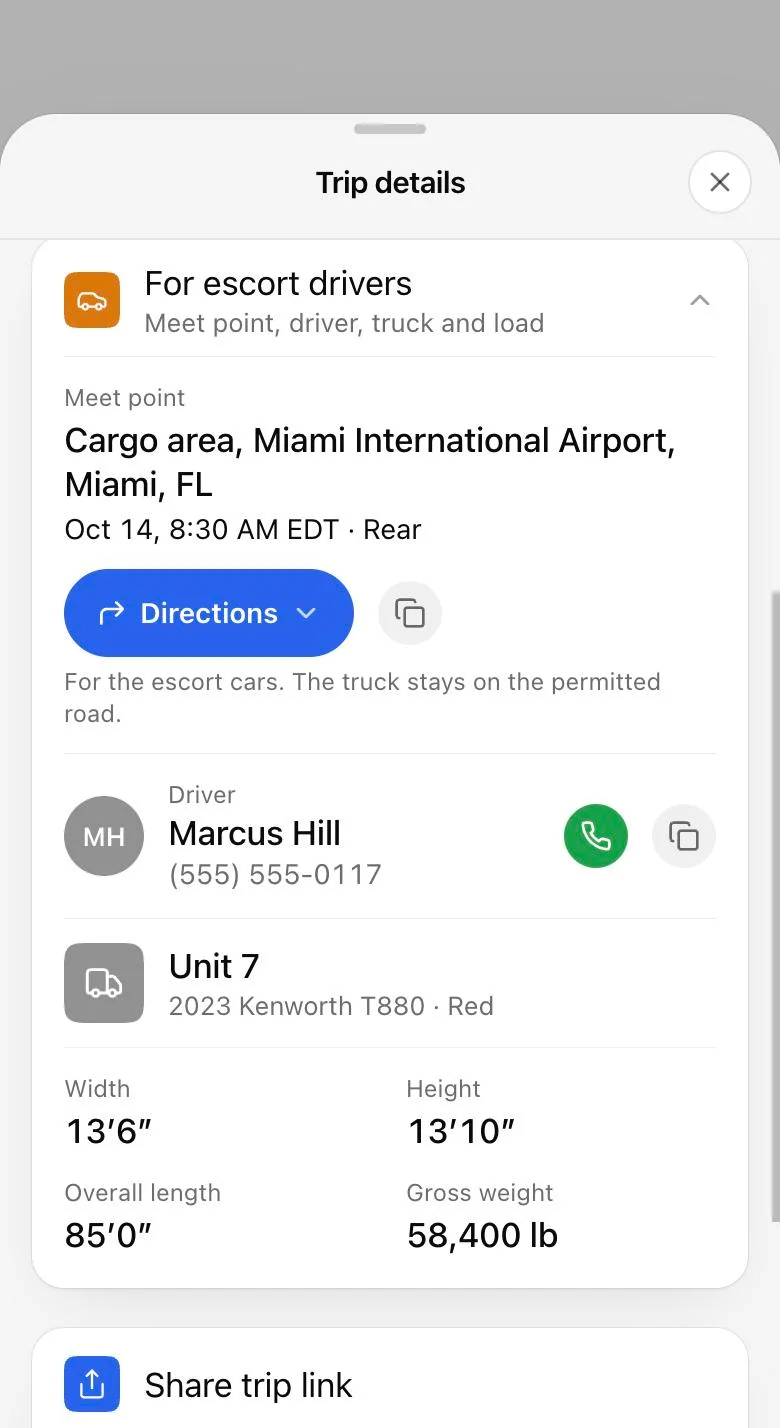
What does an escort driver need before the move?
A copy of the permit, and the truck driver within reach. Florida’s rule makes the permittee “responsible for providing the escort with a copy of the permit prior to the move”, and Louisiana’s says the escort driver “shall make certain that a permit has been issued.” The link carries every permit, so both are covered. All five states also want the escort and the truck in contact on the move: Florida, Alabama, Mississippi, Louisiana and Texas. What the escort car itself must carry is in pilot car requirements by state.
Where does the escort meet the truck?
At the meet point Permigo’s office enters in the link, with a date and time. In the example it is the cargo area at 8:30 a.m. Eastern on Wednesday, and the same crew starts again each morning from where the last day ended. That is where the pre-trip meeting happens: the Federal Highway Administration’s best practices for pilot and escort vehicles (February 2017) list assigning tasks, reviewing the route, reviewing the load’s limits and testing the radios, and on a longer trip a meeting “before getting underway each day.”
Why the link doesn’t hand the route to Google Maps
Google Maps picks the fastest road and reroutes around traffic; an oversize permit names the only roads the load may use. The Beaumont limit above is the kind of thing a navigation app does not know. So the page keeps the route inside the permit:
- The map’s line comes from the states’ permitted routes, or from a road the office drew to match them.
- Each state’s card carries the state’s own written directions where its system gives them, step by step with miles; where it gives none, the card says to go by the permit’s route map.
- The Directions buttons, in Apple Maps, Google Maps or Waze, go to one place: the pickup or a meet point.
- Trip details offers the route as a file for a Garmin navigator.
If a state’s directions and its permit disagree, the card says so: “This route doesn’t match the permit — the office is checking it. Go by the permit.”
The AI summary, and why it says to read the permit
Each issued state’s card has an AI summary, written from that state’s permit PDF and any form that travels with it. It pulls out what a driver checks before rolling: the dates the permit is valid, the travel times (curfews and holidays), the escorts (how many, where, and whether a height pole is needed), flags and lights, what the permit says about carrying it, and any other condition. It leaves out the route directions and the load’s size, which the page shows elsewhere.
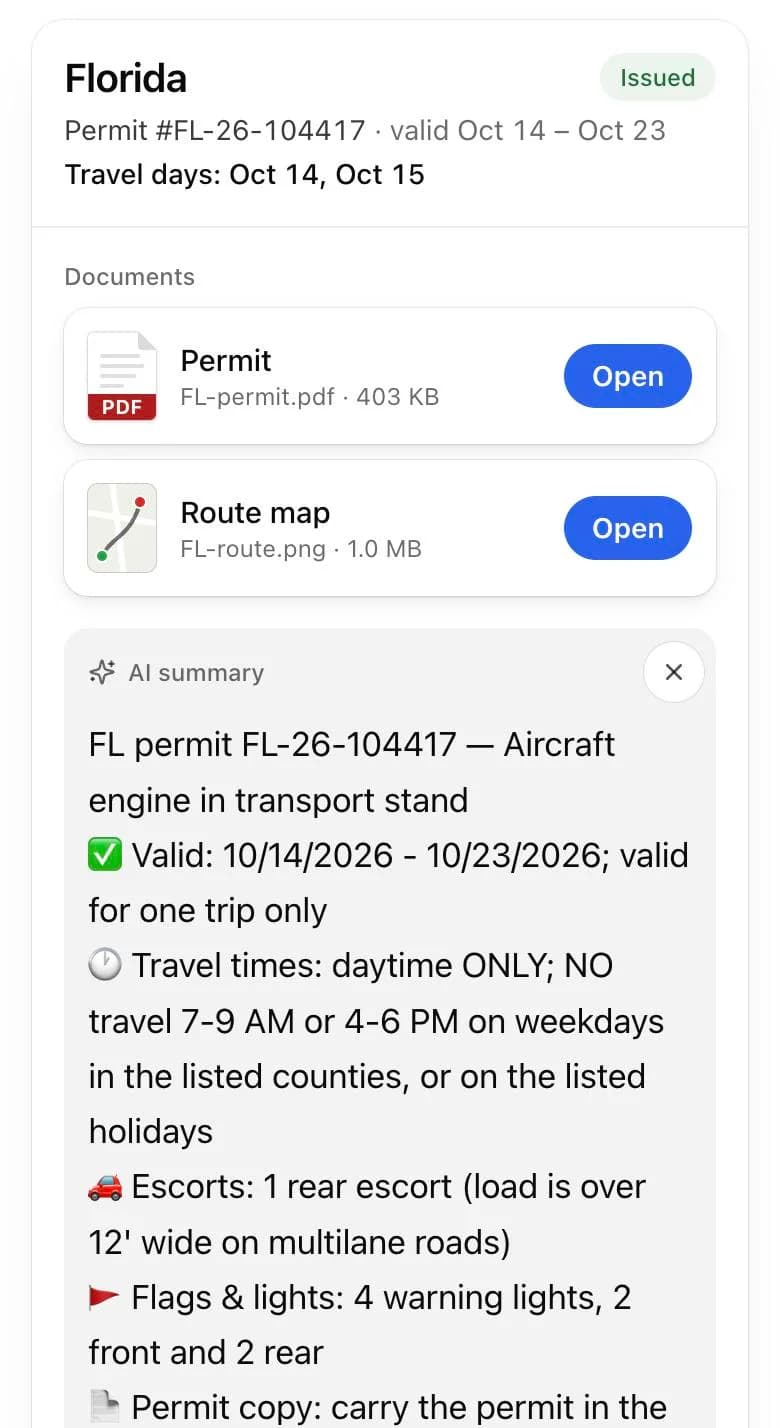
The summary is a reading aid, and the page labels it “AI summary — always read the full permit.” When the office replaces a permit file, the app writes the summary again from the new one, and it hides a summary that no longer matches its permit.
Can the driver show the permit on a phone?
As of October 8, 2026, Florida, Mississippi and Texas accept an electronic single-trip permit. So does Louisiana’s 2026 rule book, though a 1979 Louisiana rule still asks for the original. Alabama’s rule wants a copy in the vehicle and counts an emailed copy as the original, but never mentions screens. Carry Alabama’s and Louisiana’s printed. Here is each state in its own words:
| State | Answer | In the state’s words |
|---|---|---|
| Florida | Yes, if it is easy to reach and legible. | “An electronic version of a trip permit may be presented, if the trip permit is readily available and legible.” Rule 14-26.012(1) |
| Alabama | A copy must be in the truck; the rule counts the emailed copy as the original but says nothing about a screen. Carry it printed. | “A copy of the permit shall be carried in the vehicle itself… For a single trip permit, the original may be considered the copy received via email, by mail, by fax, or in person.” Rule 450-3-1-.03(2) |
| Mississippi | Yes, on a phone or a tablet. | “Electronic permits and permit numbers via smart phones and tablets will be accepted.” 2026 Permit Manual, page 8 |
| Louisiana | Yes in the 2026 rule book, though a 1979 rule still in the state code asks for the original. Carry the printout too. | “shall have the permit in their possession in written or electronic form during the movement.” 2026 rule book, page 15 |
| Texas | Yes, kept in the truck until the day after it expires. | “A copy of the permit—whether original, faxed, TxDMV computer-generated, or electronic—must be kept in the permitted vehicle until the day after the permit expires.” Motor Carrier Handbook, “Proof of Permit” |
The link holds every permit as a PDF, so a driver can print the ones a state may want on paper before leaving the yard. The AI summary’s “Permit copy” line repeats what each permit says.
Who to call on the road
The office that filed the permits answers while the load is moving, and it can change the escort cars, the meet point or the link: +1 (786) 494-6912, 7am–7pm CT, seven days a week, or send a message.
Get a quote for your next oversize trip → or calculate your route estimate in the calculator →
Common questions
How does the driver get the oversize permits?
Permigo’s office texts the driver one link when it files the trip, texts the same link to each escort car, and emails it to the dispatcher. Every filed trip gets one, at no extra charge. Each state’s permit appears on that page as a PDF once Permigo’s office receives it from the state; a state still in review shows “Not issued yet,” and the driver taps Refresh to see it land.
Does the driver need an app or an account?
No. Permigo’s driver link opens in the phone’s browser with no login, nothing to install and no FleetLynk account. Anyone with the link can open the page, so it goes only to the crew on that trip, and the page asks search engines not to list it.
Can the escort drivers use the same link?
Yes. Permigo’s office enters the escort cars and the meet point, and texts the link to each escort driver. On it they see the meet point and time, each car’s number, and, in Trip details, the truck driver’s number, the truck and the load’s size and weight.
How long does the driver’s link work?
Ninety days from the day Permigo’s office creates it, and the date is printed at the foot of the page. The office can turn a link off sooner, for example when a different driver takes the load; the old link then says “This link is no longer valid,” and the new driver gets a new one.
What happens if a permit changes after the link is sent?
The page follows it. When Permigo’s office replaces a permit file, the AI summary is written again from the new one, and the driver taps Refresh; a summary that no longer matches its permit is hidden. If a state’s written directions disagree with its permit, the card says to go by the permit.
Can the driver show the permit on a phone instead of paper?
Mostly. As of October 8, 2026, Florida, Mississippi and Texas accept an electronic single-trip permit, and so does Louisiana’s 2026 rule book, though a 1979 Louisiana rule still asks for the original. Alabama’s rule wants a copy in the vehicle and never mentions screens. Permigo’s link holds every permit as a PDF, so print Alabama’s and Louisiana’s before leaving the yard.
What does the driver link cost?
Nothing extra. As of October 2026, Permigo charges $20 flat per state permit, with each state’s own permit fee billed at cost, and every trip it files comes with the driver link. The guide’s calculator link prices the example’s five states, escort cars included.
What if there is no cell signal on the road?
The page needs a signal to open; it does not work offline. Each permit opens as a PDF the phone can save, and some states want paper anyway, so save or print the permits and read the AI summaries and the states’ directions before leaving the yard.
How do I reach Permigo about a trip?
Call or text +1 (786) 494-6912, 7am–7pm CT, seven days a week, or send a message. Permigo’s permit office answers while the load is moving and can change the escort cars, the meet point or the link.